Having tea with Medusa and other feral females
Updated 11 September 2026
Through Medusa, Sedna and Kali, this essay considers female rage as a response to violated boundaries and broken relations—and asks when its destructive force becomes protective, even life-serving.
If you really want to hear about it, you’ll probably want to know that before she spent a lousy two millennia (at least) sealed in stone at her most pissed off, Medusa was a sensational mortal woman who spent her days offering prayers in flowers and song at the feet of the one who would immortalize her. But Medusa has been in transformation, shedding her worn-out skin for a coat more suited to today’s shifting climate. Although her transformation has become especially visible over the past two decades, its serpentine trace reaches further back. When it comes to Medusa, we’ve been living under a rock.
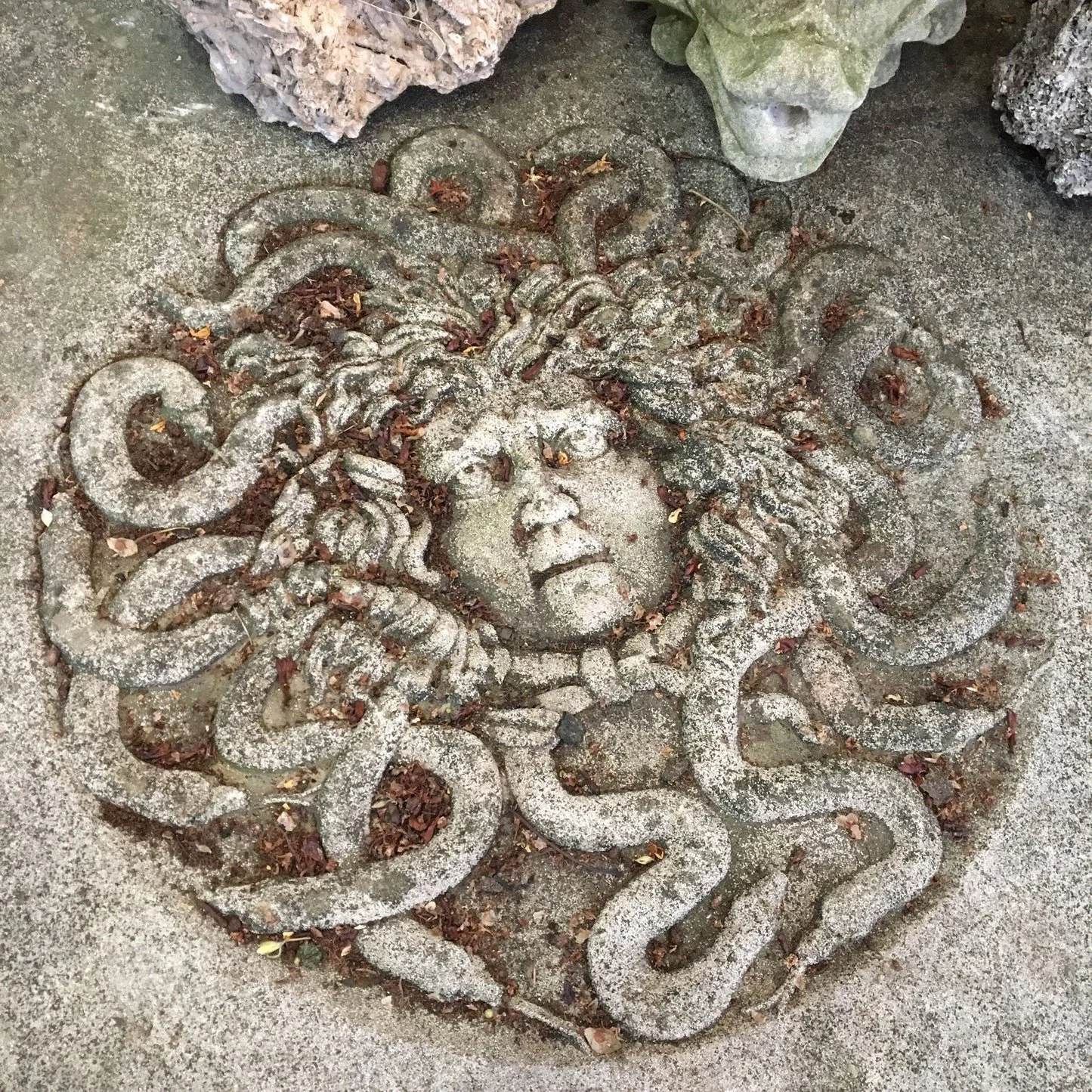
Medusa after Perseus: Beauty, Violation and Rage
Medusa is not a fixed archetype with a single universal meaning. She is a mythic image whose associations—terror, protection, violation, beauty and sovereignty—have been revised across texts, places and political moments. A Jungian reading asks what such an image constellates in contemporary psychic life; it does not attempt to establish what Medusa means once and for all.
For centuries, Medusa’s story has been told through the blade of Perseus—the hero who beheads her—while she appears as the cold, monstrous Gorgon witch whose gaze entombs whoever dares look at her. But in recent decades, she has found a new home in the passionata of feminist thought. In Ovid’s late Roman telling, Neptune violates Medusa in Minerva’s temple, after which Minerva transforms her hair into snakes. Earlier Greek traditions do not tell the same story and often present the Gorgons as monstrous from birth. The familiar sequence of beauty, sexual violation and punishment is therefore not Medusa’s single or original story, but one of the myth’s own transformations. Read through a feminist lens, it raises a sharper question: what appears when we meet Medusa where the story has left her? A decapitated female head, writhing snake hair, fierce eyes and furious. Does she feel trapped to you? Perhaps. Images travel, but they do not arrive unchanged, so perhaps there is more to her story.
Medusa as a Protective Image: Sicily and Istanbul
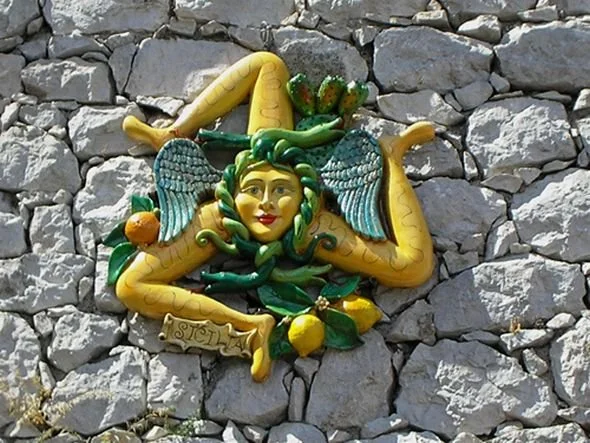
One place where Medusa’s meaning changes is Sicily, an island poised like a football at the tip of Italy’s toe and at a meeting point of Mediterranean routes. Centuries of exchange and conquest made it a meeting ground for Greek, Roman, Byzantine, Arab and Norman cultures, a social crucible where diversified ideas could slow cook. During the Sicilian Vespers of 1282, islanders rose against Angevin rule. Within weeks they slaughtered and expelled the French. According to a later tradition, the uprising began after a French soldier harassed a Sicilian woman; streets filled with the angry and armed, decrying ‘moranu li Francisi’!. Within weeks, Angevin authority had been driven from much of the island.
The trinacria—three bent legs turning around a central Gorgoneion, or Medusa-head—has much older roots in Sicily and appears on ancient coinage. Its later political uses bound the emblem to Sicilian identity; a modern version now occupies the centre of the regional flag, accompanied by wings, snakes and ears of wheat. Rather than assigning it one fixed historical meaning, this Sicilian Medusa can be read as a guardian: her petrifying gaze becomes protective, directed outward rather than back at herself. Here she is no longer only the monster defeated by a hero, but an island’s winged witness to protection, fertility and cultural identity.
Across the Ionian sea east of Italy, Turkey’s Istanbul shields a more secretive Medusa. Beneath the city’s streets lies the damp cavernous territory of the Basilica Cistern. The cistern is an underground water reservoir built in the sixth century during the reign of the Byzantine Emperor Justinian I. Constructed to supply water to the Great Palace and surrounding buildings, the cistern could hold nearly 80,000 cubic meters of water supported by marble columns, many of them taken from older Roman temples and monuments.
At the far end of the cistern sit two large stone Medusa heads used as bases beneath two columns. One lies sideways, the other upside down. The original location of the heads, and the reason one is turned sideways and the other inverted, remain uncertain. They are generally understood as spolia: stone from an earlier Roman-period structure reused within the cistern. That uncertainty does not diminish the symbolic force of their placement. In a symbolic reading, deep underground, beneath the weight of the city, Medusa supports the architecture above her. Removed from the heroic narrative of Perseus and stripped of her role as monster alone, she becomes part of the foundation of the cistern tasked with the preservation of life-giving water.
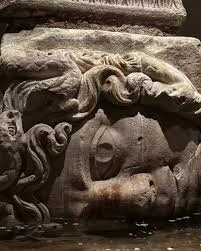
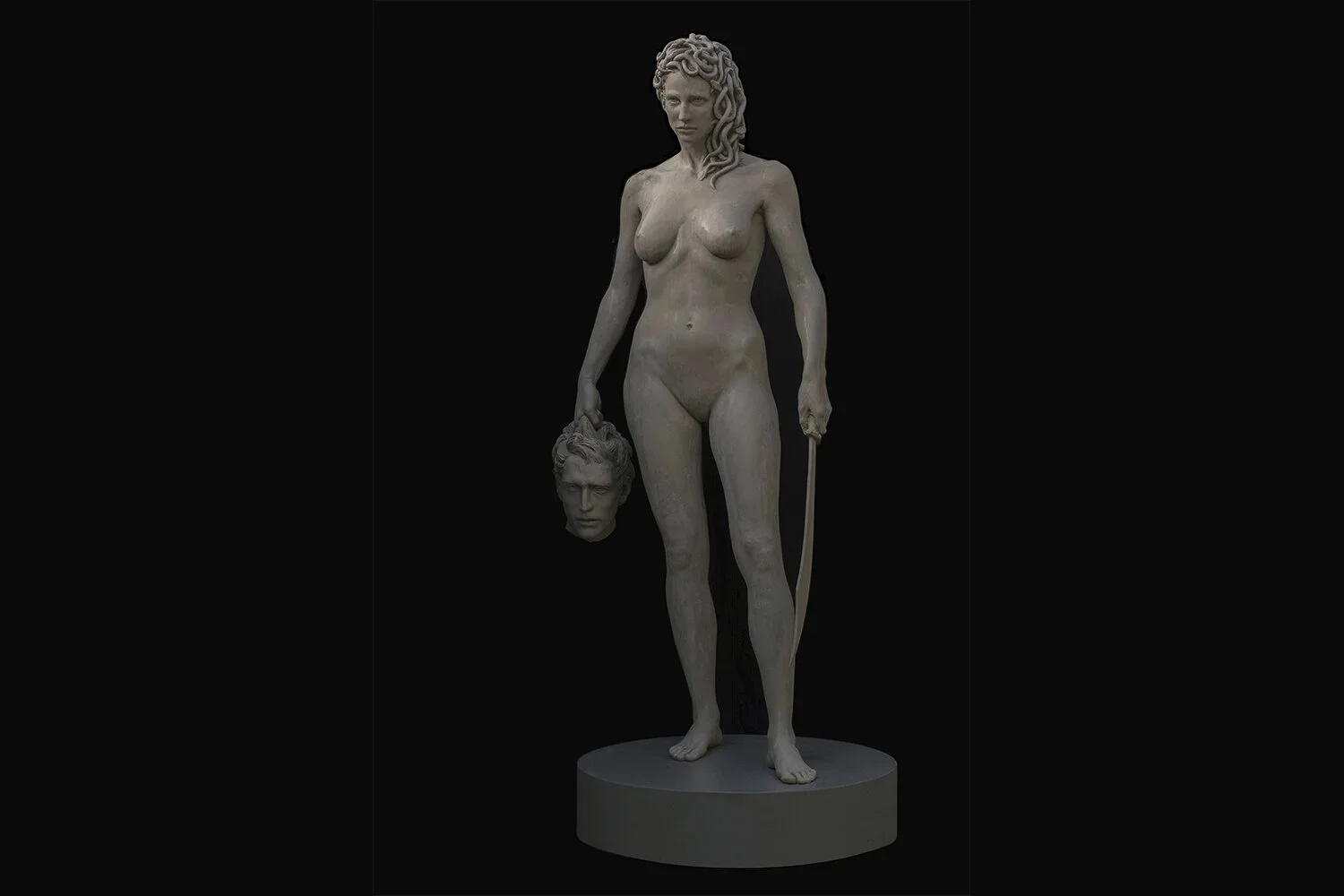
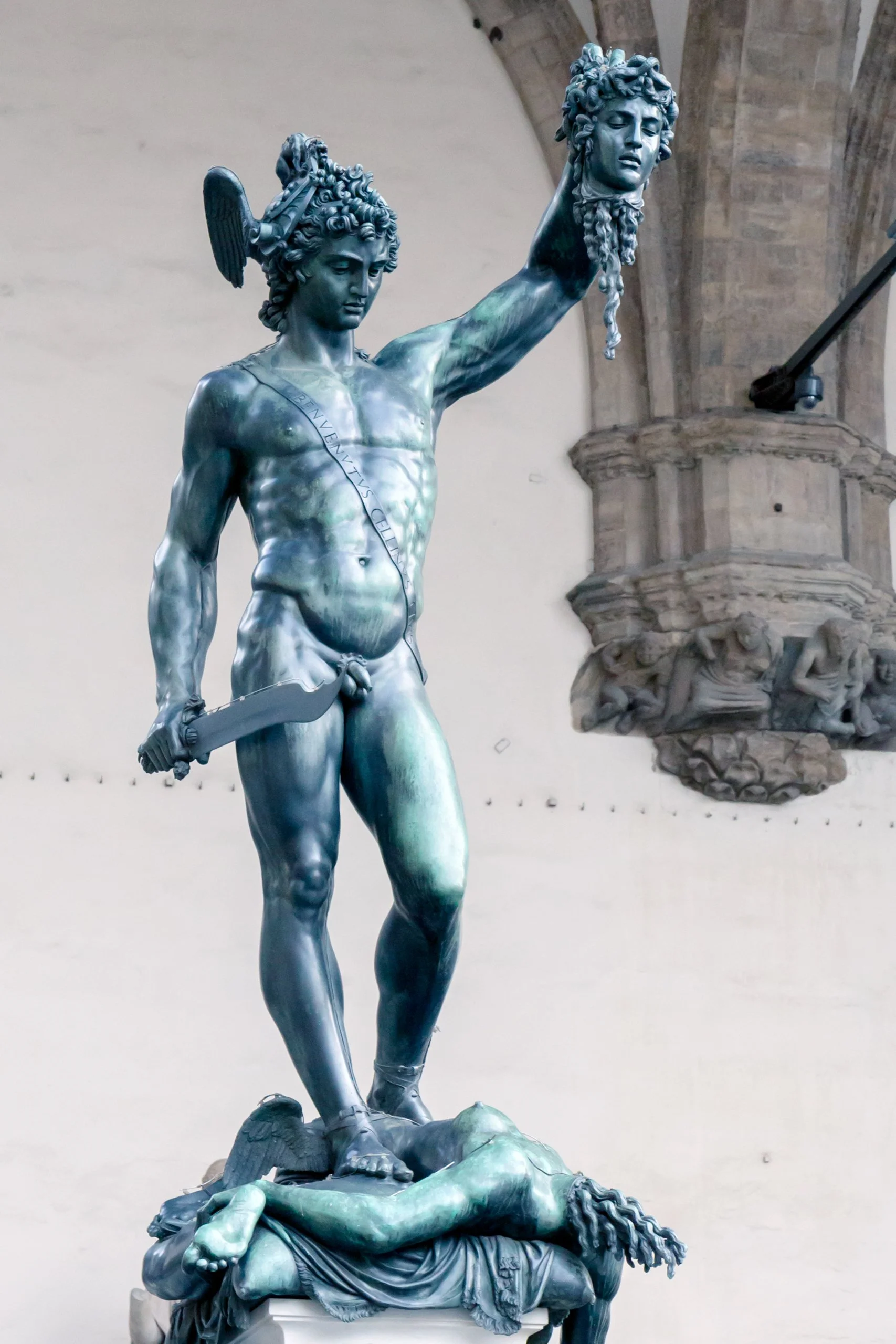
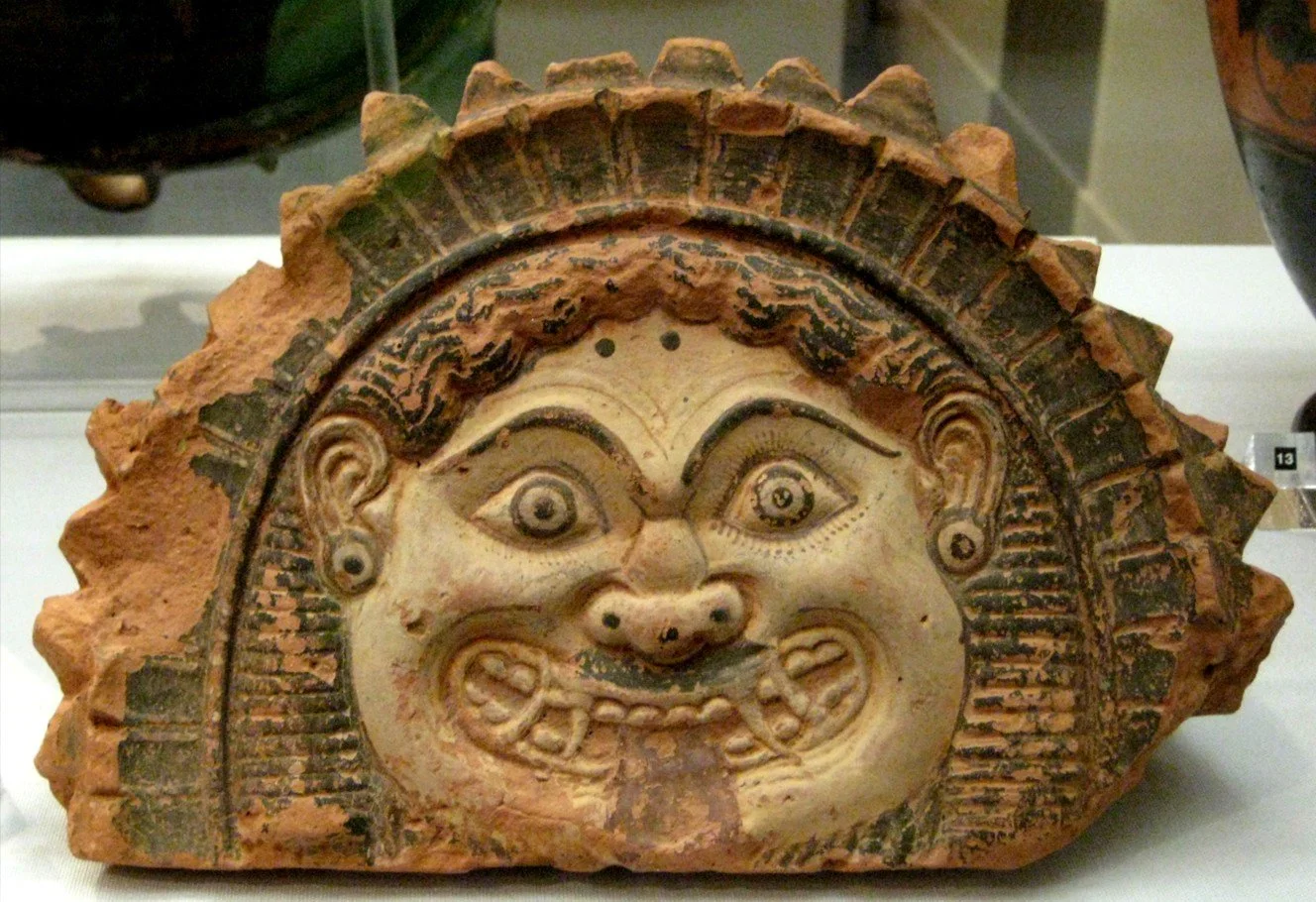
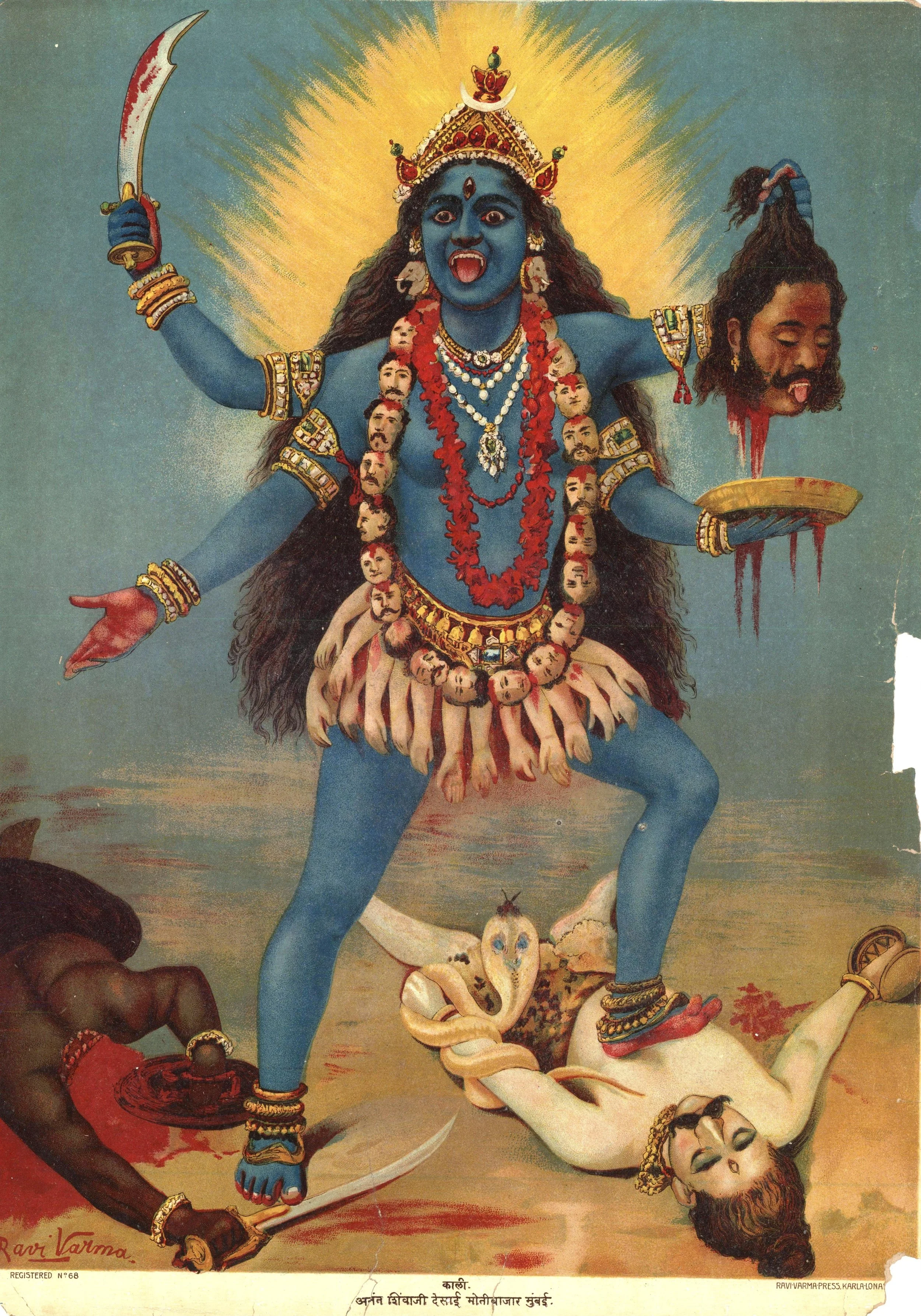
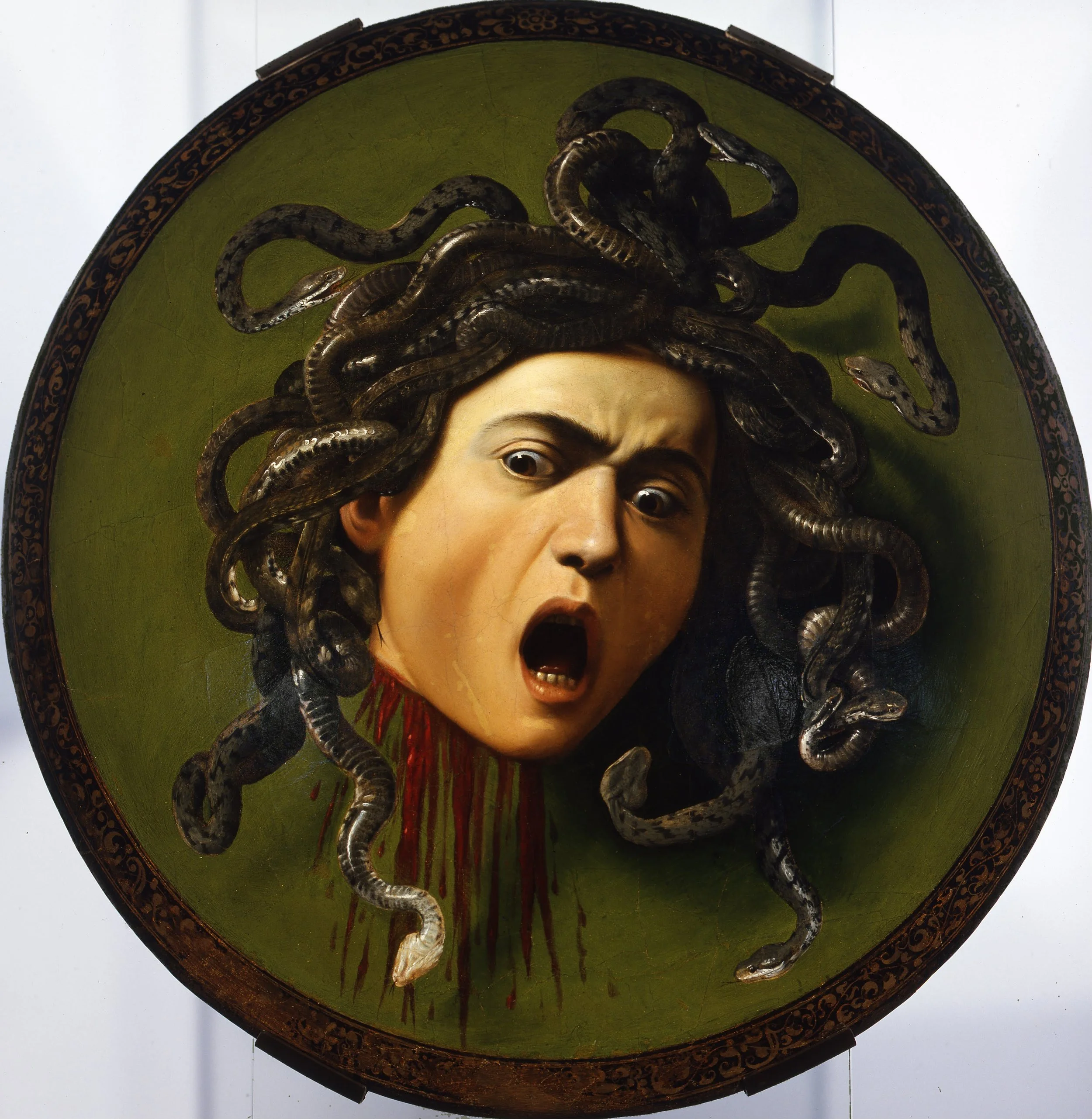
from left to right - Medusa at the Basilica Cistern, Benvenuto Cellini's 'Perseus with the Head of Medusa ', Medusa stone, Raja Ravi Varma's Kali, Carvaggio's Medusa, Luciano Garbati's Medusa with the head of Perseus
What Does Female Rage Protect? Sedna and Kali
Further north, a different figure appears: Sedna, known under several names and through distinct oral traditions across the Inuit Arctic. In many tellings, she becomes a powerful being of the sea world upon whom access to marine animals depends. In some tellings, when relations between human beings, sea animals and Sedna have been disturbed, an angakkuq (an Inuit ritual specialist,) descends to her and combs her tangled hair. As the knots are released, the animals become available to the hunters again. The episode concerns more than a generalized idea of “balance with nature”: it belongs to a particular world of obligations between human, animal and spiritual life.
In another group of tellings, Sedna is cast from a boat by her father, who cuts off her fingers as she clings to its side. Her severed fingers become seals, whales and other marine animals; Sedna sinks into the sea and becomes a powerful being of its depths. Violence and transformation are inseparable in this narrative.
Medusa, Sedna and Kali do not belong to one universal mythology, nor are their cultural and religious meanings interchangeable. They can nevertheless be placed in a careful, partial conversation. Contemporary feminist readings often find in Medusa the rage that follows sexual violation and punishment. In several Inuit traditions, Sedna’s anger is bound to ruptures in the obligations between human beings, animals and the sea. Joanna Macy, writing from systems theory and Buddhist practice, understood anger and grief about ecological destruction as signs of our capacity to care beyond the isolated self. Kali enters a different cosmological field again: in the Devi Mahatmya, her destructive force confronts powers that threaten the order of life. What these figures allow us to consider—without making them equivalent—is whether destruction can sometimes serve preservation. Anger then becomes a boundary-making No: not merely a possession of the individual, but a force that declares where relation has been violated.
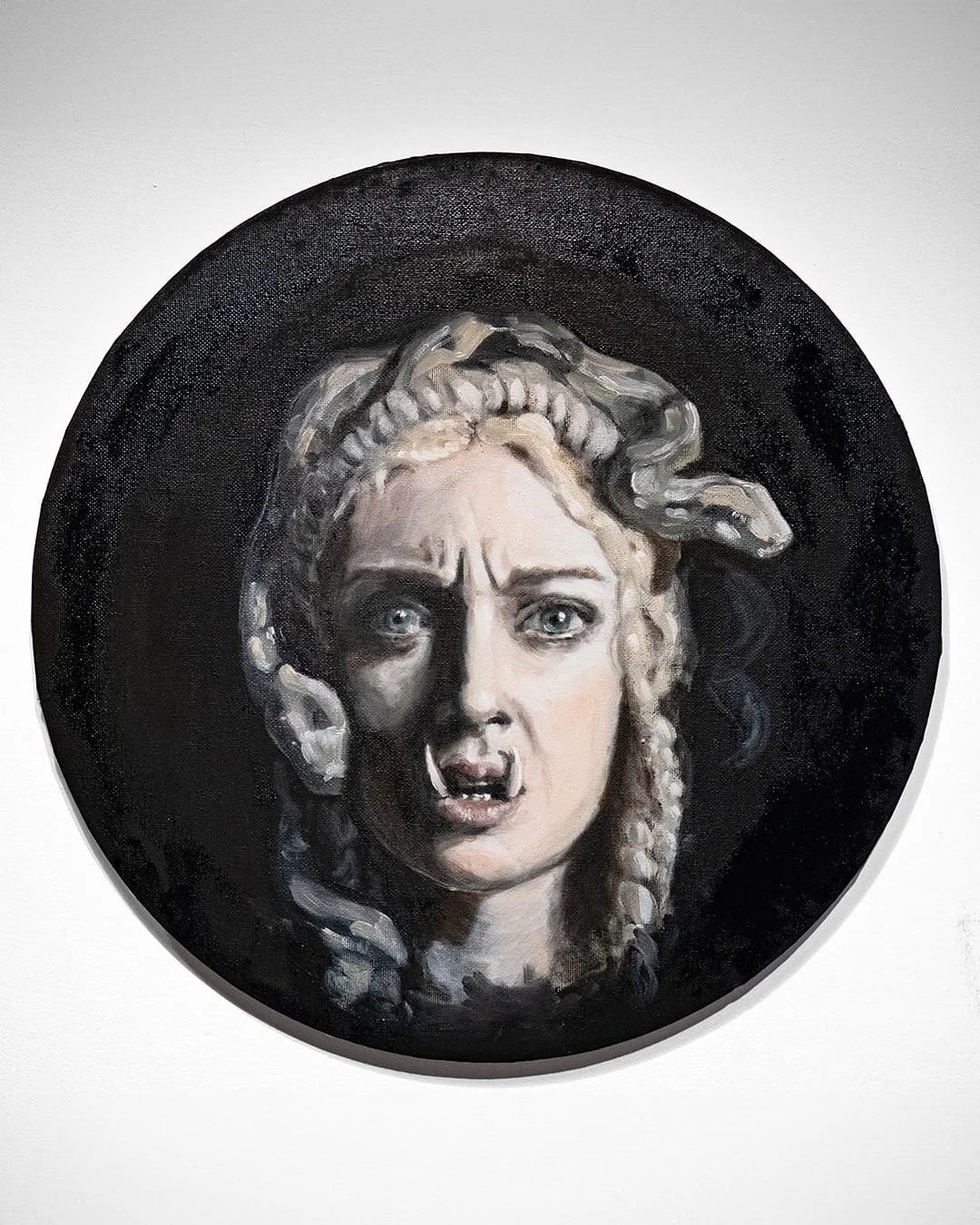
Medusa by Lotte Hauss @ Lotte Hauss & Maison Douce
Medusa and a Woman’s Right to Say No
The stories of Medusa and Sedna suggest that beneath the image lies a woman of flesh and blood whose authority is not always welcomed. Mary Beard has placed contemporary leaders including Theresa May and Angela Merkel within a much longer history of the suspicion directed at women who exercise public authority. During the 2016 American election, the connection became brutally literal: Hillary Clinton was repeatedly recast as Medusa, her severed head held aloft by a triumphant Perseus. Theresa May was recast as “Maydusa” in a 2017 political comic and during her period as Home Secretary, a Police Federation magazine reportedly called her “the Medusa of Maidenhead.”
Medusa’s archetypal image may be conspicuous in public life, but as often she is less visible. She may be the artist whose work alters how others see, or the mother whose clear presence interrupts an inherited pattern. Medusa is not only the woman made monstrous by projection; she is also the woman one might want to sit beside, to discover what knowledge anger carries.
For a woman who has learned to remain composed, useful or accommodating, anger may first appear indirectly: as exhaustion, withdrawal, recurrent conflict, bodily tension, or a dream that refuses to be interpreted away. In analysis, the question is neither how to unleash this anger nor how to suppress it, but what relation it bears to injury, boundary, desire and care. Rage left unconscious may petrify; rage attended to can become discrimination—the capacity to know what must stop, what must be protected, and what kind of life can no longer be lived.
To follow one’s own way within the connective tissue of this painfully beautiful life is also to meet opposing forces. At their most damaging, these encounters are internalised: they might turn us into stone. The experience hardens into fear, repetition, or a life organised around what once happened. The work is neither to revere the wound nor to deny it. New movement may begin in tending the wounded places with the same fierce attention Joanna Macy brings to “honouring our pain for the world”: not by sanctifying brokenness, but by recognising in pain the persistence of our relation to life. We do not have to accept the way we have been broken; some lines should not have been crossed. Care begins by attending to what has been injured without allowing the injury to define the whole life.
Such attention adds water to stone.
We give back to Medusa what the severed head conceals: wings, a body, movement and voice. We allow what was arrested there to enter life again.
My writing follows the psychological life of myth, dreams and the feminine. You can subscribe to my essays or read about my work in Jungian analysis, online and in person.
Suzanne Schreve is a Jungian analyst and writer based in the Netherlands. She works principally with women between 30 and 60 whose lives are being reorganized by recurrent patterns, motherhood, loss, relationships, (peri) menopause, creative impasses, or questions of spiritual meaning.
Sources used:
Ovid’s account of Medusa’s violation and transformationOvid, Metamorphoses, Book IV, approximately lines 790–803. The University of Virginia Ovid Collection provides access to several translations.
Archetypes and their culturally formed representations C. G. Jung, The Archetypes and the Collective Unconscious, Collected Works, vol. 9, part 1.
The Gorgoneion as a protective or apotropaic image The Metropolitan Museum of Art, “Medusa in Ancient Greek Art”.
The Sicilian Vespers and the later tradition concerning the assaulted woman Steven Runciman, The Sicilian Vespers: A History of the Mediterranean World in the Later Thirteenth Century (Cambridge University Press, 1958). Book record.
Ancient Sicilian coin imagery British Museum, Catalogue of the Greek Coins in the British Museum: Sicily, vol. 2. Digitised catalogue.
Basilica Cistern and the reused Medusa column bases John Freely and Ahmet S. Çakmak, Byzantine Monuments of Istanbul (Cambridge University Press, 2004), alongside the official Basilica Cistern museum.
Multiple Inuit traditions surrounding Sedna/NuliajukQaumajuq Winnipeg Art Gallery, “Nuliajuk’s Story”; Louise Flaherty and Neil Christopher, Kappianaqtut: Strange Creatures and Fantastic Beings from Inuit Myths and Legends (Inhabit Media).
Kali and the Devī Māhātmya Thomas B. Coburn, Encountering the Goddess: A Translation of the Devī-Māhātmya and a Study of Its Interpretation (SUNY Press, 1991). Book record.
Joanna Macy and “honouring our pain for the world”Joanna Macy and Molly Young Brown, Coming Back to Life: The Updated Guide to the Work That Reconnects.
Medusa in contemporary representations of powerful women Mary Beard, Women & Power: A Manifesto; Natalie Haynes, “If looks could kill: how Medusa became a potent political meme”.